
Privacy Policy
Table of Contents
- Introduction and Overview
- Scope of Application
- Legal Basis
- Contact Details of the Controller
- Storage Duration
- Rights according to the GDPR
- Data Transfer to Third Countries
- Security of Data Processing
- Communication
- Data Processing Agreement (DPA)
- Cookies
- Web Hosting Introduction
- Website Builder Systems Introduction
- Web Analytics Introduction
- Social Media Introduction
- Cookie Consent Management Platform Introduction
- Security & Anti-Spam
- Cloud Services
- Web Design Introduction
- Online Map Services Introduction
- Content Search Providers Introduction
- Online Booking Systems Introduction
- Explanation of Terms Used
Introduction and Overview
We have written this privacy policy (version 24.07.2023-112552241) to explain to you, in accordance with the requirements of the General Data Protection Regulation (EU) 2016/679 and applicable national laws, what personal data (data for short) we as the controller – and the processors commissioned by us (e.g., providers) – process, will process in the future, and what legal options you have. The terms used are to be understood as gender-neutral.
In short: We provide you with comprehensive information about the data we process about you.
Privacy policies usually sound very technical and use legal jargon. This privacy policy, however, is intended to describe the most important things to you as simply and transparently as possible. To the extent that it promotes transparency, technical terms are explained in a reader-friendly manner, links to further information are provided, and graphics are used. We inform you in clear and simple language that we only process personal data as part of our business activities if there is a corresponding legal basis. This is certainly not possible if one provides explanations that are as brief, unclear, and legalistic-technical as are often standard on the internet when it comes to data protection. We hope you find the following explanations interesting and informative, and perhaps there is a piece of information or two that you did not know yet.
If questions still remain, we would like to ask you to contact the responsible body named below or in the legal notice (Impressum), follow the existing links, and view further information on third-party sites. Our contact details can, of course, also be found in our legal notice.
Scope of Application
This privacy policy applies to all personal data processed by us in the company and to all personal data processed by companies commissioned by us (processors). By personal data, we mean information within the meaning of Art. 4 No. 1 GDPR, such as a person's name, email address, and postal address. The processing of personal data ensures that we can offer and bill for our services and products, whether online or offline. The scope of this privacy policy includes:
- all online presences (websites, online shops) that we operate
- social media presences and email communication
- mobile apps for smartphones and other devices
In short: The privacy policy applies to all areas in which personal data is processed structurally within the company via the channels mentioned. Should we enter into legal relationships with you outside of these channels, we will inform you separately if necessary.
Legal Basis
In the following privacy policy, we provide you with transparent information on the legal principles and regulations, i.e., the legal basis of the General Data Protection Regulation, which allow us to process personal data.
As far as EU law is concerned, we refer to REGULATION (EU) 2016/679 OF THE EUROPEAN PARLIAMENT AND OF THE COUNCIL of 27 April 2016. You can, of course, read this EU General Data Protection Regulation online on EUR-Lex, the access to EU law, at https://eur-lex.europa.eu/legal-content/EN/ALL/?uri=celex%3A32016R0679.
We only process your data if at least one of the following conditions applies:
- Consent (Article 6(1)(a) GDPR): You have given us your consent to process data for a specific purpose. An example would be the storage of the data you entered in a contact form.
- Contract (Article 6(1)(b) GDPR): We process your data to fulfill a contract or pre-contractual obligations with you. For example, if we conclude a purchase contract with you, we require personal information in advance.
- Legal Obligation (Article 6(1)(c) GDPR): We process your data if we are subject to a legal obligation. For example, we are legally obliged to keep invoices for accounting purposes. These usually contain personal data.
- Legitimate Interests (Article 6(1)(f) GDPR): In the event of legitimate interests that do not restrict your fundamental rights, we reserve the right to process personal data. For example, we must process certain data in order to operate our website safely and economically. This processing is therefore a legitimate interest.
Other conditions, such as the performance of tasks in the public interest, the exercise of official authority, and the protection of vital interests, generally do not occur in our company. Should such a legal basis be relevant, it will be indicated at the appropriate point.
In addition to the EU regulation, national laws also apply:
- In Austria, this is the Federal Act on the Protection of Natural Persons with regard to the Processing of Personal Data (Data Protection Act), or DSG for short.
- In Germany, the Federal Data Protection Act, or BDSG for short, applies.
If other regional or national laws apply, we will inform you in the following sections.
Contact Details of the Controller
If you have any questions about data protection or the processing of personal data, you will find the contact details of the responsible person or body below:
Dr. Scarlett Lewitschnig
Blumengasse 12, 9020 Klagenfurt am Wörthersee, Austria
Email:
Phone: +43 463 20 70 22
Legal Notice: https://www.lewitschnig.at/impressum/
Storage Duration
The general criterion for us is that we only store personal data for as long as is absolutely necessary for the provision of our services and products. This means that we delete personal data as soon as the reason for the data processing no longer exists. In some cases, we are legally obliged to store certain data even after the original purpose has ceased to exist, for example for accounting purposes.
Should you wish for your data to be deleted or withdraw your consent to data processing, the data will be deleted as quickly as possible and as far as there is no obligation to store it.
We will inform you below about the specific duration of the respective data processing, provided we have further information about it.
Rights according to the General Data Protection Regulation
In accordance with Articles 13 and 14 of the GDPR, we inform you about the following rights to which you are entitled to ensure fair and transparent data processing:
- According to Article 15 GDPR, you have a right of access as to whether we are processing your data. If this is the case, you have the right to receive a copy of the data and to learn the following information:
- the purpose for which we are carrying out the processing;
- the categories, i.e., the types of data that are processed;
- who receives this data and, if the data is transferred to third countries, how security can be guaranteed;
- how long the data will be stored;
- the existence of the right to rectification, erasure, or restriction of processing and the right to object to processing;
- that you can complain to a supervisory authority (links to these authorities can be found below);
- the origin of the data if we did not collect it from you;
- whether profiling is carried out, i.e., whether data is automatically evaluated to arrive at a personal profile of you.
- According to Article 16 GDPR, you have a right to rectification, which means that we must correct data if you find errors.
- According to Article 17 GDPR, you have the right to erasure ("right to be forgotten"), which specifically means that you may request the deletion of your data.
- According to Article 18 GDPR, you have the right to restriction of processing, which means that we may only store the data but no longer use it.
- According to Article 20 GDPR, you have the right to data portability, which means that we will provide you with your data in a common format upon request.
- According to Article 21 GDPR, you have a right to object, which, if enforced, results in a change in processing.
- If the processing of your data is based on Article 6(1)(e) (public interest, exercise of official authority) or Article 6(1)(f) (legitimate interest), you can object to the processing. We will then check as quickly as possible whether we can legally comply with this objection.
- If data is used for direct marketing, you can object to this type of data processing at any time. We may then no longer use your data for direct marketing.
- If data is used for profiling, you can object to this type of data processing at any time. We may then no longer use your data for profiling.
- According to Article 22 GDPR, you may have the right not to be subject to a decision based solely on automated processing (e.g., profiling).
- According to Article 77 GDPR, you have the right to lodge a complaint. This means you can complain to the data protection authority at any time if you believe that the processing of personal data violates the GDPR.
In short: You have rights – do not hesitate to contact the controller listed above!
If you believe that the processing of your data violates data protection law or your data protection claims have been violated in any other way, you can complain to the supervisory authority. For Austria, this is the Data Protection Authority, whose website can be found at https://www.dsb.gv.at/. In Germany, there is a data protection officer for each federal state. For more information, you can contact the Federal Commissioner for Data Protection and Freedom of Information (BfDI). The following local data protection authority is responsible for our company:
Austria Data Protection Authority
Head: Mag. Dr. Andrea Jelinek
Address: Barichgasse 40-42, 1030 Vienna
Phone No.: +43 1 52 152-0
Email address:
Website: https://www.dsb.gv.at/
Data Transfer to Third Countries
We only transfer or process data in countries outside the EU (third countries) if you agree to this processing, if it is required by law, or if it is contractually necessary, and in any case only to the extent generally permitted. Your consent is in most cases the most important reason why we have data processed in third countries. The processing of personal data in third countries such as the USA, where many software manufacturers offer services and have their server locations, can mean that personal data is processed and stored in unexpected ways.
We expressly point out that, in the opinion of the European Court of Justice, there is currently no adequate level of protection for data transfers to the USA. Data processing by US services (such as Google Analytics) can lead to data not being processed and stored anonymously. Furthermore, US government authorities may be able to access individual data. In addition, it may happen that collected data is linked to data from other services of the same provider if you have a corresponding user account. Wherever possible, we try to use server locations within the EU if offered.
We will inform you more precisely about data transfer to third countries at the appropriate points in this privacy policy, if applicable.
Security of Data Processing
In order to protect personal data, we have implemented both technical and organizational measures. Where possible, we encrypt or pseudonymize personal data. In this way, we make it as difficult as possible within the scope of our possibilities for third parties to draw conclusions about personal information from our data.
Art. 25 GDPR speaks here of "Data protection by design and by default" and means that security is always considered and appropriate measures are taken for both software (e.g., forms) and hardware (e.g., access to the server room). Below we will go into specific measures, if necessary.
TLS Encryption with HTTPS
TLS, encryption, and HTTPS sound very technical and they are. We use HTTPS (Hypertext Transfer Protocol Secure) to transmit data tap-proof on the internet.
This means that the complete transmission of all data from your browser to our web server is secured – no one can "eavesdrop".
In this way, we have introduced an additional layer of security and fulfill data protection through technology design (Article 25(1) GDPR). Through the use of TLS (Transport Layer Security), an encryption protocol for secure data transmission on the internet, we can ensure the protection of confidential data.
You can recognize the use of this data transmission security by the small lock symbol  at the top left of the browser, to the left of the internet address (e.g., example.com) and the use of the https scheme (instead of http) as part of our internet address.
If you would like to know more about encryption, we recommend a Google search for "Hypertext Transfer Protocol Secure wiki" to obtain good links to further information.
Communication
|
Communication Summary 👥 Data subjects: Everyone who communicates with us by phone, email, or online form 📝 Processed data: e.g., phone number, name, email address, entered form data. More details can be found under the respective type of contact 🤝 Purpose: Handling communication with customers, business partners, etc. 📅 Storage duration: Duration of the business case and legal regulations ⚖️ Legal basis: Art. 6(1)(a) GDPR (Consent), Art. 6(1)(b) GDPR (Contract), Art. 6(1)(f) GDPR (Legitimate interests) |
If you contact us and communicate by phone, email, or online form, personal data may be processed.
The data is processed for the handling and processing of your question and the related business transaction. The data is stored for as long as necessary or as long as required by law.
Data Subjects
The aforementioned processes affect everyone who seeks contact with us via the communication channels provided by us.
Telephone
When you call us, the call data is stored pseudonymously on the respective terminal device and by the telecommunications provider used. In addition, data such as name and phone number can then be sent by email and stored to answer inquiries. The data will be deleted as soon as the business case has ended and legal requirements allow.
If you communicate with us by email, data may be stored on the respective end device (computer, laptop, smartphone, ...) and data is stored on the email server. The data will be deleted as soon as the business case has ended and legal requirements allow.
Online Forms
If you communicate with us via an online form, data is stored on our web server and, if necessary, forwarded to one of our email addresses. The data will be deleted as soon as the business case has ended and legal requirements allow.
Legal Basis
The processing of the data is based on the following legal bases:
- Art. 6(1)(a) GDPR (Consent): You give us your consent to store your data and use it further for purposes related to the business case;
- Art. 6(1)(b) GDPR (Contract): There is a need for the performance of a contract with you or a processor, such as the telephone provider, or we have to process the data for pre-contractual activities, such as the preparation of an offer;
- Art. 6(1)(f) GDPR (Legitimate interests): We want to conduct customer inquiries and business communication in a professional framework. To this end, certain technical facilities such as email programs, exchange servers, and mobile network operators are necessary to be able to operate the communication efficiently.
Data Processing Agreement (DPA)
In this section, we would like to explain to you what a data processing agreement is and why it is required. Because the word "Auftragsverarbeitungsvertrag" (Data Processing Agreement) is quite a tongue twister, we will often only use the acronym DPA (or AVV in German context) here in the text. Like most companies, we do not work alone, but also use the services of other companies or individuals ourselves. By involving various companies or service providers, it may be that we pass on personal data for processing. These partners then act as processors with whom we conclude a contract, the so-called Data Processing Agreement (DPA). The most important thing for you to know is that the processing of your personal data takes place exclusively according to our instructions and must be regulated by the DPA.
Who are processors?
As a company and website owner, we are responsible for all data we process from you. In addition to the controllers, there can also be so-called processors. This includes every company or every person who processes personal data on our behalf. To be more precise and according to the GDPR definition: any natural or legal person, authority, institution, or other body that processes personal data on our behalf is considered a processor. Processors can therefore be service providers such as hosting or cloud providers, payment or newsletter providers, or large companies such as Google or Microsoft.
For a better understanding of the terminology, here is an overview of the three roles in the GDPR:
Data Subject (you as a customer or interested party) → Controller (we as a company and client) → Processor (service providers such as web hosters or cloud providers)
Content of a Data Processing Agreement
As mentioned above, we have concluded a DPA with our partners who act as processors. Above all, it states that the processor processes the data to be processed exclusively in accordance with the GDPR. The contract must be concluded in writing, although in this context electronic contract conclusion is also considered "in writing". The processing of personal data only takes place on the basis of the contract. The contract must contain the following:
- Binding to us as the controller
- Obligations and rights of the controller
- Categories of data subjects
- Type of personal data
- Type and purpose of data processing
- Subject matter and duration of data processing
- Place of implementation of data processing
Furthermore, the contract contains all obligations of the processor. The most important obligations are:
- To ensure data security measures
- To take possible technical and organizational measures to protect the rights of the data subject
- To keep a record of processing activities
- To cooperate with the data protection supervisory authority upon request
- To carry out a risk analysis with regard to the personal data received
- Sub-processors may only be commissioned with the written permission of the controller
Cookies
|
Cookies Summary 👥 Data subjects: Visitors to the website 🤝 Purpose: depending on the respective cookie. More details can be found below or from the manufacturer of the software that sets the cookie. 📝 Processed data: Depending on the cookie used. More details can be found below or from the manufacturer of the software that sets the cookie. 📅 Storage duration: depending on the respective cookie, can vary from hours to years ⚖️ Legal basis: Art. 6(1)(a) GDPR (Consent), Art. 6(1)(f) GDPR (Legitimate interests) |
What are Cookies?
Our website uses HTTP cookies to store user-specific data.
Below we explain what cookies are and why they are used so that you can better understand the following privacy policy.
Whenever you surf the internet, you use a browser. Well-known browsers include Chrome, Safari, Firefox, Internet Explorer, and Microsoft Edge. Most websites store small text files in your browser. These files are called cookies.
One thing cannot be denied: cookies are really useful helpers. Almost all websites use cookies. To be more precise, they are HTTP cookies, as there are also other cookies for other areas of application. HTTP cookies are small files that are stored by our website on your computer. These cookie files are automatically placed in the cookie folder, the "brain" of your browser, so to speak. A cookie consists of a name and a value. When defining a cookie, one or more attributes must also be specified.
Cookies store certain user data of yours, such as language or personal page settings. When you call up our site again, your browser transmits the "user-related" information back to our site. Thanks to the cookies, our website knows who you are and offers you the setting you are used to. In some browsers, each cookie has its own file, in others, such as Firefox, all cookies are stored in a single file.
The following graphic shows a possible interaction between a web browser such as Chrome and the web server. The web browser requests a website and receives a cookie back from the server, which the browser uses again as soon as another page is requested.
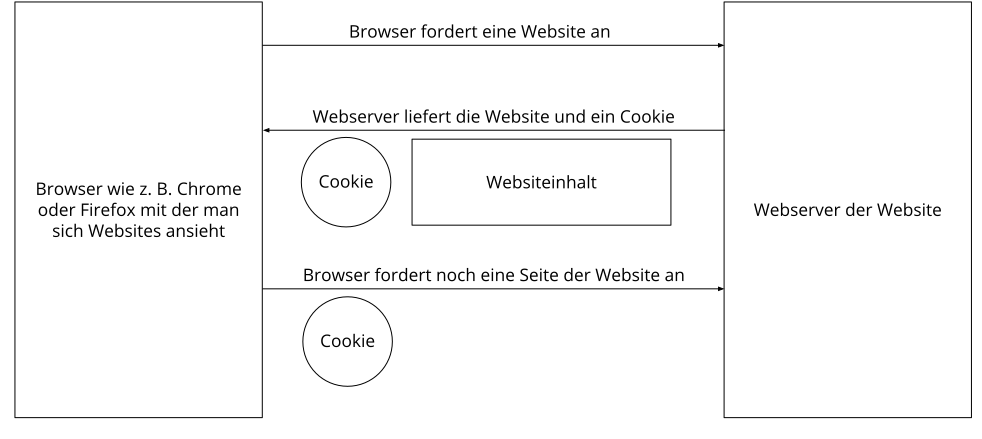
There are both first-party cookies and third-party cookies. First-party cookies are created directly by our site, third-party cookies are created by partner websites (e.g., Google Analytics). Each cookie is to be evaluated individually, as each cookie stores different data. The expiration time of a cookie also varies from a few minutes to a few years. Cookies are not software programs and do not contain viruses, trojans, or other "pests". Cookies also cannot access information on your PC.
For example, cookie data can look like this:
Name: _ga
Value: GA1.2.1326744211.152112552241-9
Purpose: Differentiation of website visitors
Expiration date: after 2 years
What types of cookies are there?
The question of which cookies we use in particular depends on the services used and will be clarified in the following sections of the privacy policy. At this point, we would like to briefly discuss the different types of HTTP cookies.
One can distinguish between 4 types of cookies:
Essential Cookies
These cookies are necessary to ensure basic functions of the website. For example, these cookies are needed if a user puts a product in the shopping cart, then continues surfing on other pages and only goes to the checkout later. These cookies ensure that the shopping cart is not deleted, even if the user closes their browser window.
Functional Cookies
These cookies collect information about user behavior and whether the user gets any error messages. In addition, these cookies are also used to measure the loading time and the behavior of the website with different browsers.
User-oriented Cookies
These cookies ensure better user-friendliness. For example, entered locations, font sizes, or form data are stored.
Advertising Cookies
These cookies are also called targeting cookies. They serve to deliver individually adapted advertising to the user. This can be very practical, but also very annoying.
Usually, when you visit a website for the first time, you are asked which of these cookie types you want to allow. And of course, this decision is also stored in a cookie.
Right to object – how can I delete cookies?
You decide for yourself how and whether you want to use cookies. Regardless of which service or website the cookies come from, you always have the option of deleting, deactivating, or only partially allowing cookies. For example, you can block third-party cookies but allow all other cookies.
If you want to find out which cookies have been stored in your browser, if you want to change or delete cookie settings, you can find this in your browser settings:
Chrome: Delete, enable and manage cookies in Chrome
Safari: Manage cookies and website data in Safari
Firefox: Clear cookies and site data in Firefox
Internet Explorer: Delete and manage cookies
Microsoft Edge: Delete and manage cookies
Legal Basis
Since 2009, there have been so-called "cookie guidelines". These state that the storage of cookies requires consent (Article 6(1)(a) GDPR) from you. Within EU countries, however, there are still very different reactions to these guidelines. In Austria, however, this guideline was implemented in Section 96 (3) of the Telecommunications Act (TKG). In Germany, the cookie guidelines were not implemented as national law. Instead, the implementation of this guideline largely took place in Section 15 (3) of the Telemedia Act (TMG).
For strictly necessary cookies, even if no consent is given, there are legitimate interests (Article 6(1)(f) GDPR), which in most cases are of an economic nature. We want to provide visitors to the website with a pleasant user experience, and certain cookies are often absolutely necessary for this.
Insofar as cookies that are not strictly necessary are used, this only happens in the event of your consent. The legal basis in this respect is Art. 6(1)(a) GDPR.
Web Hosting Introduction
|
Web Hosting Summary 👥 Data subjects: Visitors to the website 🤝 Purpose: professional hosting of the website and securing the operation 📝 Processed data: IP address, time of the website visit, browser used, and other data. More details can be found below or from the respective web hosting provider. 📅 Storage duration: depending on the respective provider, but usually 2 weeks ⚖️ Legal basis: Art. 6(1)(f) GDPR (Legitimate interests) |
What is Web Hosting?
When you visit websites nowadays, certain information – including personal data – is automatically created and stored, including on this website. This data should be processed as sparingly as possible and only with justification. By website, we mean the entirety of all web pages on a domain, i.e., everything from the home page to the very last subpage (like this one). By domain, we mean for example example.de or sample-example.com.
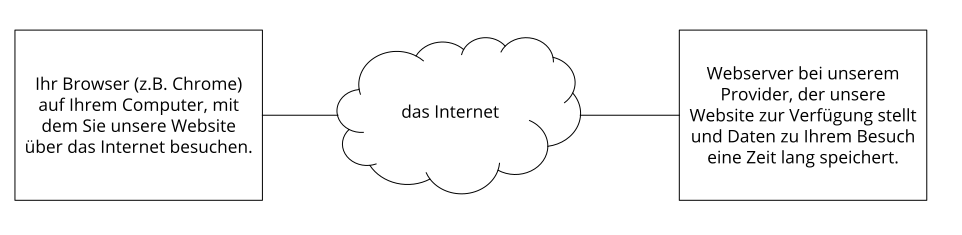
To display the website, the browser must connect to another computer where the code for the website is stored: the web server. Operating a web server is a complicated and time-consuming task, which is why it is usually taken over by professional providers. These offer web hosting and thus ensure reliable and error-free storage of website data.
Legal Basis
The lawfulness of the processing of personal data within the framework of web hosting results from Art. 6(1)(f) GDPR (protection of legitimate interests), because the use of professional hosting with a provider is necessary to be able to present the company securely and in a user-friendly manner on the internet and to be able to track attacks and claims resulting therefrom if necessary.
There is usually a contract for data processing according to Art. 28 f. GDPR between us and the hosting provider, which ensures compliance with data protection and guarantees data security.
WordPress.com Privacy Policy
We use the well-known content management system WordPress.com for our website. The service provider is the American company Automattic Inc., 60 29th Street #343, San Francisco, CA 94110, USA.
How secure is the data transfer at WordPress?
WordPress also processes data from you in the USA. We point out that, in the opinion of the European Court of Justice, there is currently no adequate level of protection for data transfers to the USA. This can be associated with various risks for the lawfulness and security of data processing.
As a basis for data processing for recipients based in third countries (outside the European Union, Iceland, Liechtenstein, Norway, i.e., in particular in the USA) or a data transfer there, WordPress uses so-called Standard Contractual Clauses (= Art. 46 (2) and (3) GDPR). Standard Contractual Clauses (SCC) are templates provided by the EU Commission and are intended to ensure that your data also complies with European data protection standards if it is transferred to third countries (such as the USA) and stored there. Through these clauses, WordPress undertakes to comply with the European data protection level when processing your relevant data, even if the data is stored, processed, and managed in the USA. These clauses are based on an implementing decision of the EU Commission. You can find the decision and the corresponding standard contractual clauses here, among other places: https://eur-lex.europa.eu/eli/dec_impl/2021/914/oj?locale=en
Google reCAPTCHA Privacy Policy
Our primary goal is to secure and protect our website for you and for us in the best possible way. To ensure this, we use Google reCAPTCHA from Google Inc. For the European area, the company Google Ireland Limited (Gordon House, Barrow Street Dublin 4, Ireland) is responsible for all Google services. With reCAPTCHA, we can determine whether you are really a human being of flesh and blood and not a robot or other spam software.
Google Fonts Privacy Policy
We use Google Fonts on our website. These are the "Google fonts" from Google Inc. For the European area, the company Google Ireland Limited (Gordon House, Barrow Street Dublin 4, Ireland) is responsible for all Google services. To use Google fonts, you do not have to log in or provide a password. Furthermore, no cookies are stored in your browser. The files (CSS, fonts) are requested via the Google domains fonts.googleapis.com and fonts.gstatic.com.
Google Maps Privacy Policy
We use Google Maps from Google Inc. on our website. For the European area, the company Google Ireland Limited (Gordon House, Barrow Street Dublin 4, Ireland) is responsible for all Google services. With Google Maps, we can better show you locations and thus adapt our service to your needs. By using Google Maps, data is transmitted to Google and stored on Google servers.
Explanation of Terms Used
We always strive to write our privacy policy as clearly and understandably as possible. However, especially with technical and legal topics, this is not always easy. Below you will find an alphabetical list of important terms used that we may not have addressed sufficiently in the previous privacy policy.
Supervisory Authority
Definition according to Article 4 of the GDPR
For the purposes of this Regulation, the term:
“supervisory authority” means an independent public authority which is established by a Member State pursuant to Article 51;
Personal Data
Definition according to Article 4 of the GDPR
For the purposes of this Regulation, the term:
“personal data” means any information relating to an identified or identifiable natural person (‘data subject’); an identifiable natural person is one who can be identified, directly or indirectly, in particular by reference to an identifier such as a name, an identification number, location data, an online identifier or to one or more factors specific to the physical, physiological, genetic, mental, economic, cultural or social identity of that natural person;
All texts are protected by copyright.
Source: Created with the Privacy Policy Generator from AdSimple